
OSHA Hot Work – Fire Watch Safety
$14.95
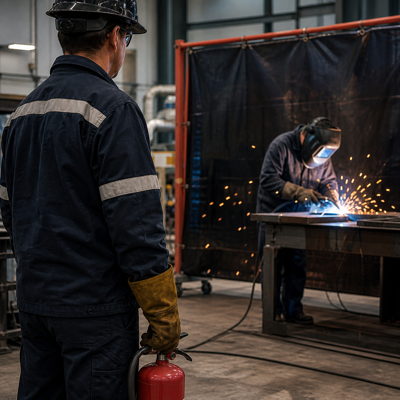
The online OSHA Hot Work – Fire Watch Safety certification course provides you with important information about fire prevention, reporting incidents to the fire department and providing essential information. Aligned with OSHA and NFPA standards and guidelines.
Instant access course
- Begin training immediately after checkout
- Train on any device
- Money back guarantee
Fire watch plays an important role in fire prevention, promptly reporting incidents to fire departments and imparting essential information about the type of fire. Fire watchers are not always responsible for extinguishing these fires unless the fire is assessed as small enough for them to do so safely.
The online Hot Work – Fire Watch Safety training program is developed in alignment with OSHA training requirements and is based on OSHA’s 29 CFR 1910.252(a)(2)(iii)(A) – Fire Watch and the NFPA 51B Chapter 4.4 – Fire Watch guidelines.
The course covers understanding when a fire watch is needed, the associated duties and the repercussions if those duties are not taken seriously; and the best practices for emergency response and workplace safety.
OSHA Fire Watch Safety Course Outline
| Fire Watch Safety Module | Lessons & OSHA Training Compliance Summary (29 CFR 1910.252) |
|---|---|
| 1. OSHA Requirements |
• Introduction to hot work hazards and the OSHA requirements for welding, cutting, brazing, and other spark- or heat-producing work. • Conditions requiring a fire watch, including combustible materials within 35 feet, open floor or wall penetrations, and ignition risks on the opposite side of walls, ceilings, or partitions. • Understanding hot-work authorization, pre-job inspections, permits, and the importance of making the work area fire-safe before work begins. |
| 2. Duties and Responsibilities |
• Core responsibilities of the fire watch, hot-work operator, supervisor, and authorizing individual before, during, and after the work. • Monitoring exposed areas for sparks, slag, heat transfer, and hidden ignition hazards in nearby or adjoining spaces. • Recognizing when conditions have changed and when hot work must be paused until hazards are corrected. |
| 3. Equipment and Training |
• Fire-watch equipment readiness, including suitable extinguishing equipment, communication methods, and safe access to emergency exits. • Basic inspection of the work area, protective screens, spark containment measures, and equipment positioning. • Training expectations: understanding the assigned task, recognizing fire hazards, knowing alarm procedures, and using available emergency equipment safely. |
| 4. Use of Fire Extinguishers |
• Selecting appropriate fire-extinguishing equipment based on the work environment and combustible materials present. • Safe, practical extinguisher-use principles and the limits of attempting to control a fire with available equipment. • When to stop firefighting efforts, sound the alarm, evacuate, and activate the site emergency response plan. |
| 5. Duration and Emergency Response |
• Maintaining a fire watch throughout hot work and for at least 30 minutes after welding or cutting is completed, with longer monitoring when required by site conditions or permit procedures. • Identifying smoldering fires and delayed ignition risks in concealed spaces, ducts, floors, walls, and nearby combustible materials. • Emergency-response actions: alarm activation, notification, evacuation, accountability, and clear information-sharing with responders. |
| 6. Personal Protective Equipment (PPE) |
• PPE considerations for fire-watch personnel, including eye, hand, foot, and protective clothing requirements based on the work area and hazards present. • Understanding the difference between fire-watch PPE and the specialized protection required by welders, cutters, and other hot-work operators. • Safe positioning to avoid exposure to sparks, radiant heat, fumes, moving equipment, and restricted exit routes. |
| 7. Communication and Additional Precautions |
• Clear communication between the fire watch, hot-work operator, supervisor, and other affected personnel. • Precautions for combustible floors, openings, ducts, conveyors, sprinkler impairments, flammable atmospheres, and adjacent work areas. • Documentation, permit closeout, and reporting practices that support consistent hot-work safety procedures. |
Only logged in customers who have purchased this product may leave a review.
Reviews
There are no reviews yet.